Guided Reminiscence Usage Guide
Table of Contents
Use these links to jump to the sections below.
- Welcome!
- How does my subscription work?
- How will each email be formatted?
- What are the best ways to use Guided Reminiscence?
- How do I cancel my subscription?
- More questions? Get in touch!
Welcome!
Thank you for joining Guided Reminiscence, Gentle Recall’s premium subscription service. This guide will help you use the system and get to a deeper connection with the person in your care. Bookmark this page for future reference.
Any time you have a question that isn’t addressed here, please get in touch. You will receive an answer and it will get published here for others’ benefit.
Your Guided Reminiscence subscription takes the regular Gentle Recall prompts to another level.
How Does My Subscription Work?
When you subscribe, you will immediately receive an email with much of the information contained in this Usage Guide. That will help you get started conveniently and effectively.
About an hour later, you will receive your first Guided Reminiscence volume. Another email will arrive every Monday, Wednesday, and Friday. Each edition will be new, with unique and engaging topics.
You will automatically be charged $5.99 each month and can cancel at any time through a link in the footer of each email.
Each volume will have five Gentle Recall prompts, but in an expanded format to assist you with Guided Reminiscence. There will be a short description of the origins of the prompt, plus 3 suggested questions for you to consider asking.
How Will Each Email Be Formatted?
Each email will be formatted the same way, with an example shown below. They will be formatted for easy viewing on a computer screen, tablet, or mobile phone.
In each email, a link to a PDF will be provided. This PDF will have the same contents as the current email. However, it will be carefully formatted to fit on one page, if you decide to print it. This is totally optional.
Guided Reminiscence Format
Each email will have five Gentle Recall prompts, with expanded content for deeper Guided Reminiscence discussion. Each of the five prompts in every email will follow this same format:
You can’t teach an old dog new… tricks.A 16th century proverb suggesting that it can be challenging to change someone’s habits or ways of thinking, especially if they’ve been doing something a certain way for a long time. |
Best Ways to Use
Pre-read
Overall, it is best to briefly familiarize yourself with the information in each email, before beginning your interaction. This is especially true for the questions. The goal is to be more conversational and less “nosy,” following the conversation naturally.
While you are welcome to ask these questions as they are, the intent is to give you creative ideas. During your pre-read, you may find a slight variation is a much better fit in your situation. In fact, the suggested question may spark an idea in you for a completely different one, based on your relationship with the one in your care.
Recall Prompt as Subject
The purpose of each prompt is to start with a recall action, connecting to a certain memory. However, the short description of the prompt’s meaning and history could be a topic of conversation itself.
For example, if the person had a direct connection to the topic – through the prompt – it could be an opportunity for even deeper discussion and connection. It could allow a “Wow, I didn’t know that…” type of introduction. Then follow it up with “…and didn’t you do this or that?”
Every person’s background is different and can trigger memories in very different ways. The best strategy is to make adjustments as needed and then ride the conversation wherever it wants to go.
Optional: Start with Background as a “Preview”
If needed, you can vary the sequence slightly and start an interaction with a preview discussion. Do that by talking about the background of the prompt first, before introducing it. If needed, this can be effective in getting the participant somewhat oriented to it before you share the prompt itself. Then continue with deeper discussion though the questions.
There are No Wrong Answers
When practicing Guided Reminiscence, the goal is not necessarily an accurate response, but an engaged response. Just triggering a memory has its benefits. Instead of correcting, enjoy that connection. An important element of dementia care is not to correct, but to foster continued interaction.
When a Prompt Doesn’t Work
That will happen. Skip it or come back later. The next prompt in that volume may make a solid connection. It may be a simple matter of the right topic, but at the wrong time for them.
Dos and Don’ts
- Don’t quiz. While the questions are meant to be an avenue for discussion, this isn’t a final exam.
- Do be conversational. Softening the tone of the questions will make it seem more natural as a way to explore a topic.
- Don’t correct. The goal is not to seek the right answer, but to encourage recall, interaction, and hopefully, conversation around a topic. Don’t worry if the facts don’t quite line up exactly.
- Do follow emotional memories. Even if responses are not 100% factually accurate, it is the emotional connections that will make an impact.
- Don’t force every question. It’s OK to skip around, make up new questions, or simply omit one in today’s session. Not every prompt works every day. Take the path of least resistance to get to that connection point.
- Do allow silence. Each person processes thoughts differently. Sometimes, they just need a few moments to access the memory. Filling the silence with chit-chat probably won’t help.
- Don’t overdo it. If today’s session achieved one good memory and discussion and that’s all the participant wants, fine. You’ve had a successful interaction. Come back later or the next day to see if that’s a better time.
- Do change topics freely. This is related to not overdoing it. If you find a certain topic not gaining any traction, go ahead and transition to a new one. The next topic might be the fuel to spark a wonderful connection!
Optional PDF
Printing the included PDF is completely optional. Each email is carefully formatted for easy reading on a computer or a mobile device. Use what’s best for you.
How Do I Cancel Guided Reminiscence?
When your needs change, it is easy to cancel your Premium subscription. There is an “Update Your Profile” link at the bottom of each Guided Reminiscence email.
When you click it, a 6-digit code will be emailed to you. We do this for security reasons. Enter the code into the screen that appears next. It looks like this:
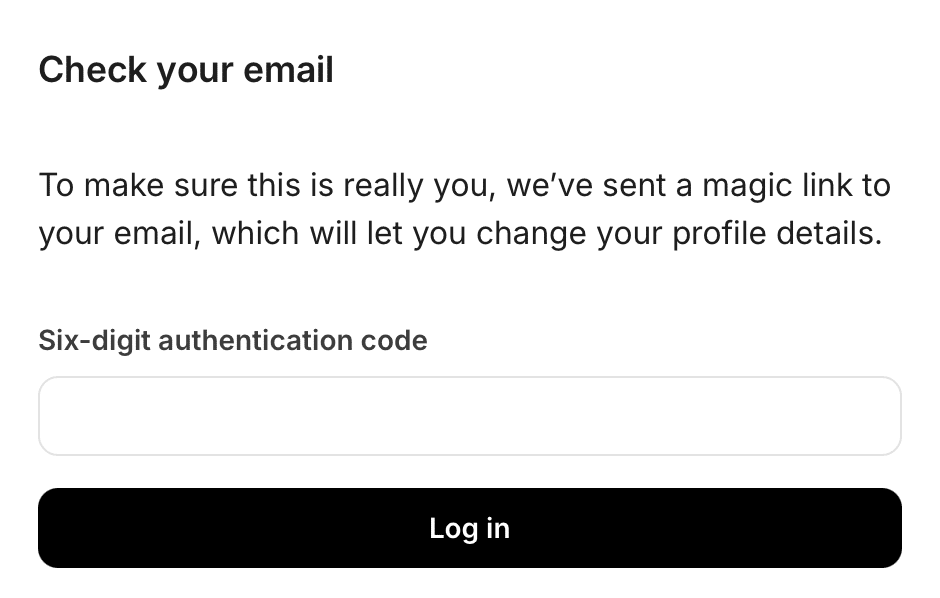
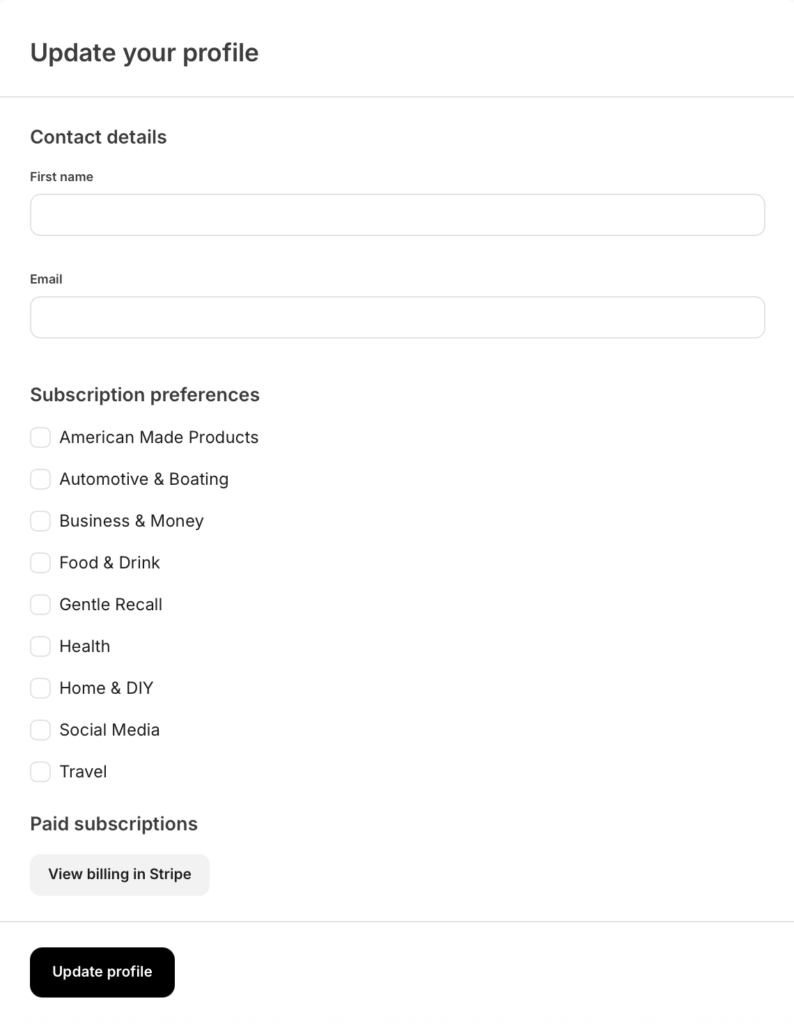
This takes you to your profile. Under “Paid Subscriptions” click “View Billing in Stripe” (our credit card processor.) There, you can cancel your subscription.
Your profile also allows you to choose which free email alerts you receive, based on your interests. The is different from the Guided Reminiscence Premium subscription. The profile screen looks like this:
Thank You
Thank you for subscribing to Gentle Recall’s Guided Reminiscence Premium service! My hope is that it provides value for helping you make deeper connections.
You will receive a new set of Guided Reminiscence prompts every Monday, Wednesday, and Friday. Each edition will be new, with unique and engaging topics.
Get in touch with any questions, feedback, or suggestions.
Very best regards,
Dave Wiederrich
JADCOM Media LLC